
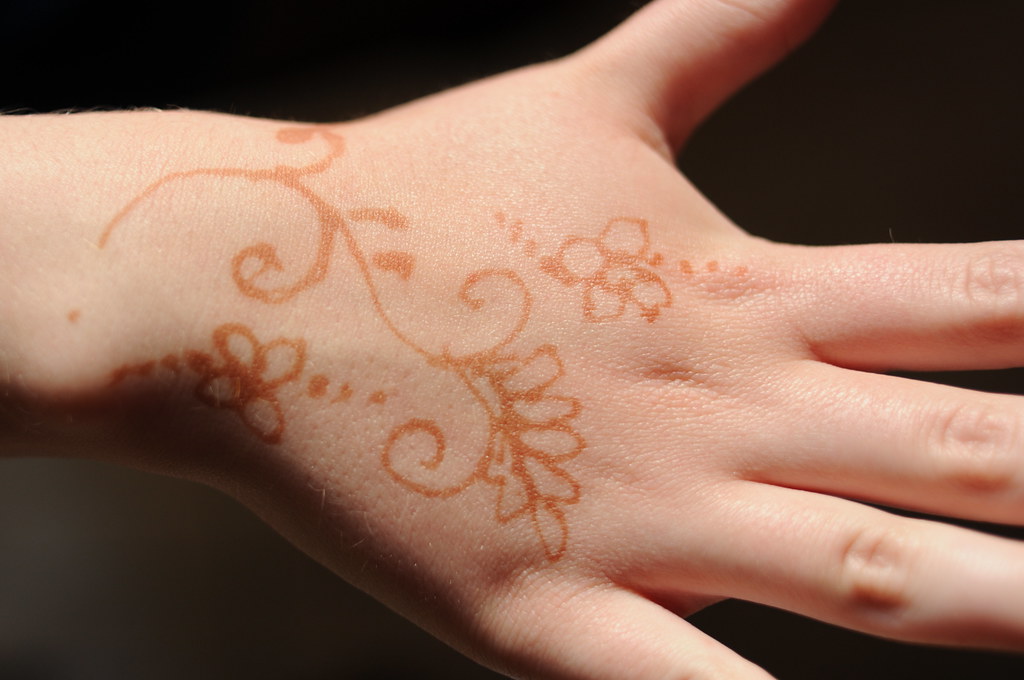
Henna is a dye made from dried, powdered leaves of Lawsonia inermis, used to produce reddish stains used in body art. It originates in North Africa and the Middle East, and has been used since at least antiquity across the region, including in ancient Egypt, as well as in ancient Mesopotamia and broader pre-Islamic Arabian cultures, as a hair and body dye, notably in the temporary body art of mehndi (or “henna tattoo”) resulting from the staining of the skin using dyes from the henna plant. After henna stains reach their peak colour, they hold for a few days and then gradually wear off by way of exfoliation, typically within one to three weeks.
Henna has been used in ancient Egypt, ancient Near East and the Indian subcontinent to dye skin, hair, and fingernails; as well as fabrics including silk, wool, and leather. Historically, Henna originates from North Africa, particularly ancient Egypt and the Maghreb (including present-day Morocco, Algeria, and Tunisia), as well as from the Middle East, including the Arabian Peninsula and West Asia. From these regions, its use gradually spread to Carthage and other parts of West Africa, Central Africa, the Horn of Africa, and later to the Indian subcontinent, as well as Eastern Europe; particularly in the Balkan, North Caucausian, Crimean, and Volga regions among Turkic, Slavic, Vlach, Albanian, and Kavkaz people.
The name henna is used in other skin and hair dyes, such as black henna and neutral henna, neither of which is derived from the henna plant.